

.png)
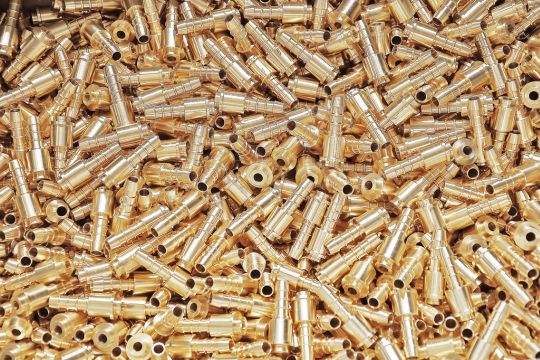
A CNC-machined component can meet every requirement in an initial production run. Producing it at a much higher volume brings a different set of manufacturing considerations. With CNC machining for high volume production, a process that produces a few hundred conforming parts needs to be reevaluated before scaling to thousands or hundreds of thousands.
Scaling successfully requires a repeatable process that maintains specifications without losing too much production time to handling, setup, and interruptions. As production increases, cycle time, tooling, inspection, material flow, secondary operations, and available machine capacity have a greater effect on how many parts can be produced consistently and on schedule.
The right approach depends on the component’s geometry, material, tolerances, required quantity, inspection requirements, and machining process. Higher volume can improve production efficiency, although whether CNC machining remains cost-effective depends on the part and its manufacturing requirements.
What Changes as CNC Production Scales?
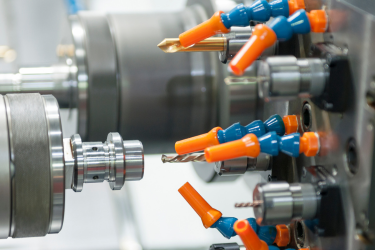
The drawing can stay the same as quantities increase, even though producing more parts requires a different production strategy. At lower quantities, programming, setup, and other fixed production work are spread across fewer components. As quantities rise, those costs can be distributed across more parts.
At higher quantities, time and costs outside the actual cutting process add up across the production run. Manufacturing cost can include setup, workholding, inspection, and other activities beyond cutting the component itself.
The time spent producing each part, or its cycle time, adds up differently at higher quantities. Cutting even a small amount from each production cycle can have little effect on a short run, but that time savings is repeated across every part in bulk CNC manufacturing.
That makes the full manufacturing sequence worth reviewing, including:
- Setup and programming: How much preparation is required before sustained production begins?
- Tooling: How frequently will tools require adjustment or replacement during the run?
- Loading and unloading: How much machine and operator time is spent moving material and completed parts?
- Inspection: What measurements are needed during production to confirm the process remains stable?
- Secondary operations: Does the component move to other equipment for additional machining or finishing?
- Capacity: Can the required quantity be completed within the production schedule without creating a capacity problem elsewhere?
- Repeatability: Can the process continue producing parts to specification throughout the run and when recurring production resumes?
Throughput depends on how these parts of the process work together. A machine may be capable of producing the component, but production planning still has to determine whether the complete process can produce the required quantity on schedule.
Build the Process Around Repeat Production
High-volume efficiency starts before continuous production begins. How well the process scales comes down to the part itself, the machining process used, and how the job is set up, tooled, and carried through each required operation.
Before increasing quantities, it helps to review the part for manufacturability and identify any features that could add setups, make tools harder to access, extend machining time, or require more handling. Those features also help determine which machining process fits the component. A part designed mainly around high-volume precision turning, for example, calls for a different production approach than one with extensive milled features.
Once the process is selected, the next consideration is how many operations can be completed without moving the part to another machine or setup. Process consolidation can shorten production time when the equipment and component allow several operations to be completed in the same setup. Reducing transfers between machines can remove handling and additional setup time from the production sequence.
How that works depends on the machining process. Production CNC milling can use dedicated fixtures, pallet changers, or other workholding and automation strategies when they suit the job. For turned components, bar-fed production can automatically advance material through a lathe instead of requiring an operator to load each blank individually. Bar feeders keep turning operations supplied with material so production can continue with less manual loading.
Material also needs to be considered because material type and condition can affect cutting behavior, tool wear, chip formation, and machining conditions. For example, NIST research comparing additively manufactured and cast-wrought Inconel 625 found differences in tool temperature and wear, cutting forces, and chip formation.
Secondary operations need to be considered as part of the overall production plan. Speeding up the primary machining process only goes so far if the next operation cannot keep up with the increased output.
When Swiss Machining Fits High-Volume Parts
Swiss-type CNC machining can be a strong process choice for small-diameter, slender, or complex turned components. Whether it fits a high-volume job still depends on the part’s geometry and production requirements.
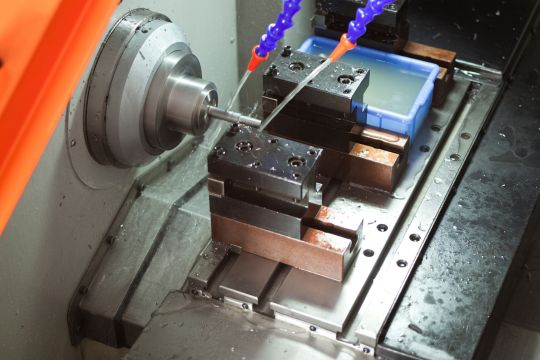
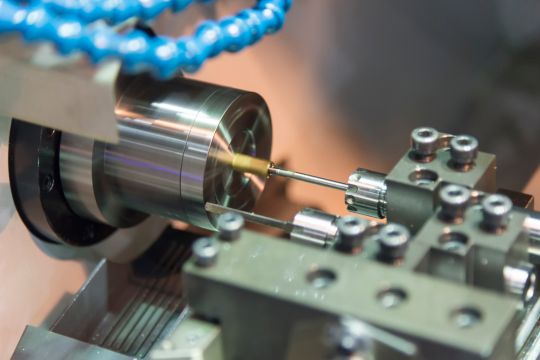
In a traditional Swiss-type configuration, the sliding headstock feeds the bar through a guide bushing that supports the material close to the cutting area. This arrangement can help control deflection when machining slender components. Depending on the machine configuration, live tooling, main and sub spindles, and multiple cutting axes can also allow turning, drilling, milling, and back-working operations to be combined within the production cycle.
Combining operations can reduce the number of times a component must be moved to separate equipment. Bar feeding can further suit recurring turned-part production by supplying new material as each machining cycle is completed.
Whether Swiss machining fits the job still depends on the part’s diameter, length, geometry, material, tolerances, and required features.
Reduce Cycle Time Without Sacrificing Quality
Cycle time optimization looks at where time can be saved throughout the machining process without affecting stability or the required part specifications.
Potential time savings can come from:
- Tool paths and cutting parameters: Unnecessary movements can add time without performing useful machining. Cutting conditions should also be selected for the material, tool, and feature.
- Simultaneous operations: Machines capable of performing compatible operations at the same time may reduce the total production cycle when the component geometry allows it. Some Swiss-type machines, for example, are designed to machine on the main and sub spindle simultaneously.
- Loading and unloading: Suitable automation can reduce the amount of manual handling between cycles. Bar feeders are one example for recurring turned-part production.
- Process consolidation: Completing more features in one setup can reduce transfers and separate machining operations.
- Tool-change planning: Tool life needs to be considered so tools can be changed before wear begins to affect part dimensions or disrupt production.
- Palletized production: For suitable milling applications, pallet changers can allow work to be prepared while machining continues, reducing time spent waiting for the next workpiece or fixture.
- Secondary machining: When the equipment allows it, compatible secondary machining operations can be completed in the same setup instead of sending the part to another machine.
Continuous machining and lights-out manufacturing can further increase machine utilization by extending production into periods with limited operator involvement. However, unattended production only works when the process is stable enough to run that way. Material supply, tooling, chip control, part handling, equipment condition, and quality controls all need to be accounted for.
Automation should be tied to a specific production constraint, not used to compensate for an unstable or poorly planned process.
What Actually Lowers Cost Per Part?
Higher production quantities can lower cost per part by spreading fixed programming and setup expenses across more components. However, quantity is only one part of the calculation. The economics of scaling CNC machining to mass production depend on the complete process.
Cost per part is influenced by:
- Setup and programming
- Machine cycle time
- Tooling consumption and tool life
- Material use and scrap
- Operator involvement and manual handling
- Number of setups
- Secondary operations
- Inspection requirements
- Downtime and production interruptions
Fewer setups and less manual handling can lower production costs by reducing machine transfers and operator time. Longer production runs require tooling to be monitored and replaced before wear affects part dimensions or interrupts production.
The same principle applies when evaluating cost per part for high-volume turning. The piece price needs to be weighed alongside quality, delivery requirements, capacity, and process reliability. A lower quoted unit price can lose its advantage if inconsistent production leads to rejected components or delays the customer’s production schedule.
Recurring orders can also benefit from a process that has already been developed around repeat manufacturing. Fixtures, tooling plans, programs, inspection requirements, and production procedures can be set up for the job and reused on future runs when the component and its requirements remain the same. Cost per part depends on where production time, setup, handling, or other expenses can be reduced while still meeting the drawing and production requirements.
Keep Quality Consistent as Volume Increases
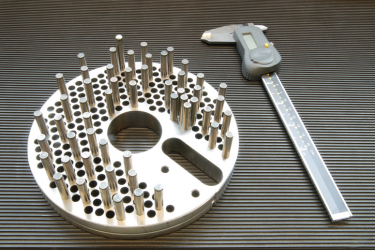
High-volume production requires process controls capable of maintaining required dimensions throughout the run and across future recurring orders. A successful first article does not guarantee that every component produced afterward will remain within specification.
Tool wear is one reason this matters. NIST has identified tool wear, tool deflection, and part deflection as sources of machining error that can affect dimensional accuracy. So, before production begins, critical dimensions and tolerances should be established, along with an inspection approach based on the drawing and customer requirements.
Production run quality assurance for tight tolerances can include both in-process monitoring and final inspection. On-machine and in-process dimensional measurement are established methods for checking part dimensions while production is underway, with inspection frequency based on the component, tolerance requirements, process stability, customer requirements, and applicable quality procedures.
The same applies to dimensional drift. Tool wear, thermal conditions, setup variation, and other process factors can change over an extended run, so manufacturers need controls that can identify changes before parts fall outside specification. Recent NIST work continues to identify thermal deformation as a significant source of machine-tool error that can affect part quality.
For close tolerance component manufacturing, inspection planning and process repeatability help keep critical dimensions within specification throughout the production run. If the customer requires specific inspection or quality records, those documentation requirements also need to be clear before production begins.
What Should You Review Before Scaling?
To plan higher-volume production, the supplier needs the part specifications and production requirements along with the expected quantity.
High-Volume CNC Production Checklist
Before increasing production volume, review:
- Current drawing or CAD: Confirm the current revision and complete component geometry.
- Critical dimensions and tolerances: Identify the features requiring the greatest dimensional control.
- Material and specification: Provide the required material, grade, and any applicable specifications.
- Production quantity: State the expected size of the production run.
- Recurring demand: Explain whether this is one large order or production expected to repeat.
- Required schedule: Specify when components are needed and whether deliveries will be phased.
- Surface finish: Identify functional or drawing-specific finish requirements.
- Secondary operations: Include additional machining, finishing, or processing required for the finished component.
- Inspection and documentation: Identify any required inspection records, reports, or other documentation.
- Existing production or capacity concerns: If the component is already in production, identify known problems involving cycle time, quality, capacity, tooling, or supplier performance.
Providing this information allows a machine shop to evaluate process fit, tooling, capacity, inspection requirements, and the complete production sequence before quoting or scaling the job.
Plan High-Volume Production Around the Part
As CNC production scales, the process needs to handle the higher volume without losing control of cycle time, tooling, handling, capacity, inspection, or repeatability. The production strategy should start with the actual drawing, material, tolerances, quantity, recurring demand, and required schedule. Those requirements help determine whether changes to setup, tooling, automation, process consolidation, inspection, or machining method would improve the production plan.
For small precision components, Swiss machining can provide an effective path to recurring high-volume production when the geometry and requirements fit the process. Manufacturers evaluating a new or existing component should discuss the complete production requirement with their machining supplier before increasing quantities. See examples of Aaero Swiss's precision machining work in its CNC machined components portfolio.